
How to use MoSCoW prioritisation for better product roadmaps
This guide breaks down the MoSCoW technique, shows you how to apply it, and offers tips to avoid common pitfalls.
SERVICE DESIGN


During product roadmapping, every decision can feel like a “must.” When approached with shiny new feature requests, improvement suggestions, and stakeholder feedback, design teams can find it hard to figure out what needs immediate attention and what can wait. The MoSCoW prioritisation method helps clear up that confusion. It organises how decisions are made and lets teams create practical roadmaps that match their goals.
What Is MoSCoW prioritisation?
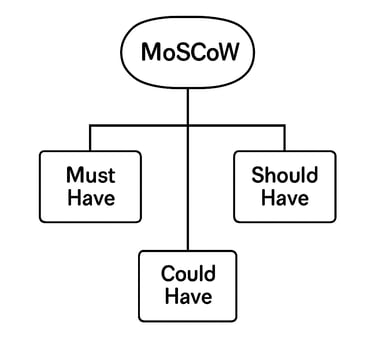
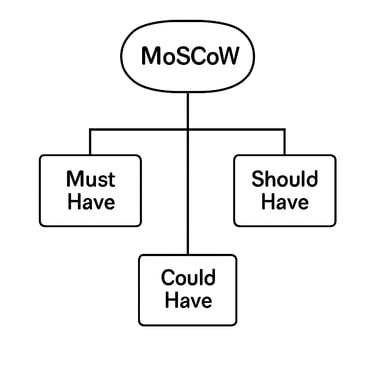
MoSCoW is a technique that allows for the prioritisation of product features or tasks into four main categories:
Must-Have: Required or necessary for the launch and success of the product.
Should-Have: Quite important, but not essential. They are not needed immediately.
Could-Have: If time and resources permit, this would be nice to have.
Won't-Have (for now): Not the focus for this cycle, but worth considering later.
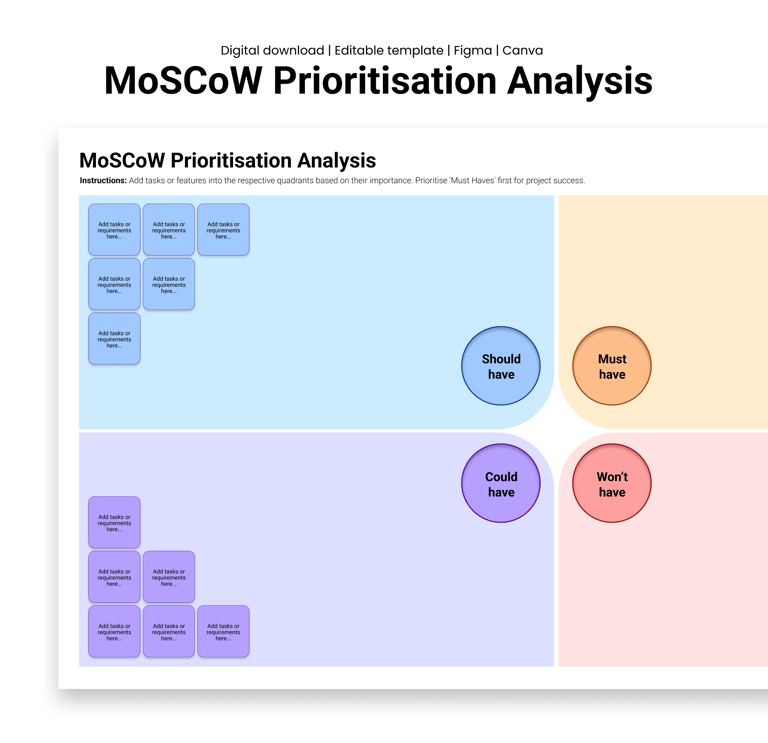
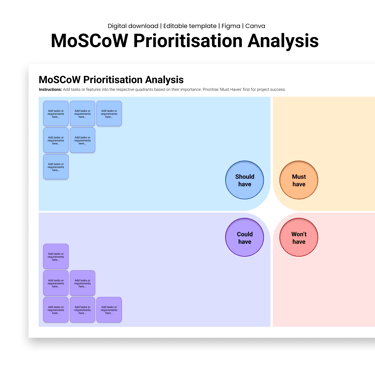
Veilworx has a ready-to-use MoSCoW prioritisation analysis template tailored to make work easier for you. Check it out and get ready to enjoy a streamlined planning session!
MoSCoW originated from Agile development but has become popular across product teams, and startups. It is loved for its simplicity, which aids collaboration and forces teams to think intentionally during feature prioritisation.
Benefits of using MoSCoW in roadmapping
Using MoSCoW helps everyone on product teams understand what should be given priority. Here's how:
Cross-functional teams (design, product, engineering) decide together on what features are preeminent and remain aligned.
It helps manage the expectations of stakeholders involved by showing what is realistically possible and why.
The scope of the project is controlled as it prevents distractions and last-minute requests from derailing your initial plan.
It provides strategic clarity as the entire team is encouraged to think long-term instead of planning reactively.
How to use MoSCoW in your product roadmap
Here is a step-by-step guide on how you can apply Moscow in a product roadmapping session:
List Out Your Features or Initiatives: Begin by making a list of everything on the table, including features, fixes, experiments, and improvements.
Create a Criteria List to Use for Evaluation: What makes a given feature important? Is it revenue-related, user feedback, or based on the technology involved? Decide what defines success from the beginning.
Sort Requirements Using MoSCoW: Categorise each item on your list into Must, Should, Could, or Won't. Be honest about trade-offs. Ask yourself: What happens if this is not part of the product?
Allow Team Input and Consensus: Ask your cross-functional team what they think. It allows everyone to participate and gives you a richer perspective from the start.
Revisit Regularly: Priorities shift. Be sure to review your MoSCoW as a standard practice during roadmap check-ins or feature deliberation meetings.
Tips for making it work
Now that you know the step-by-step foundation of MoSCoW, here are a few things to keep in mind to get the most out of this prioritisation method:
Don't cram everything into the “Must-Haves.” If everything is deemed necessary, then nothing is. Be ruthless and intentional in your filtering.
Resort to visual tools. A physical or digital MoSCoW board will help everyone see what is in play and how features compare. You can even use a prioritisation matrix.
Document all your decisions. Capture the why behind each categorisation. This will ensure that future reviews go smoothly and prevent repeated arguments over the same things.
Involve your stakeholders early. Provide them with the framework and talk about your ideas before finalising. It helps you garner support.
Link items to broader strategic goals. This helps to keep your roadmap grounded in results and outcomes, not just tasks.
Why MoSCoW prioritisation?
MoSCoW prioritisation is an easy-to-use, lightweight framework that provides clarity during road mapping, feature prioritisation, or general product planning. It helps erase ambiguity, facilitate team alignment, and ensure everyone remains focused on the set priorities.
If you have a roadmap session or feature deliberation meeting scheduled soon, use MoSCoW to structure your decisions and observe how clearer and more defined the conversation becomes. Wondering where to find one?
Design resources that deliver results
Copyright © Veilworx Ltd 2024. All rights reserved.
Registered in England and Wales.
Company number: 15318142

Contact
Email: contact@veilworx.com
Address:
Office 9944, 182-184 High Street North East Ham London
E6 2JA
Business hours:
Monday to Saturday: 10am to 6pm
Sun: Closed