
When and how to use affinity mapping versus mind mapping
Discover the differences between affinity maps and mind maps, and learn when and how to use each research method based on your design goals.
USER RESEARCH


Designing or developing a product often demands a common understanding from team members, and this is usually achieved with all kinds of visualisation techniques or mappings. Affinity mapping and mind mapping are two of the most common, and while they sound alike, they serve very different purposes. If you’ve ever wondered when to use either of them, this article will help you understand their differences, strengths, and best use cases for both.
What is affinity mapping?
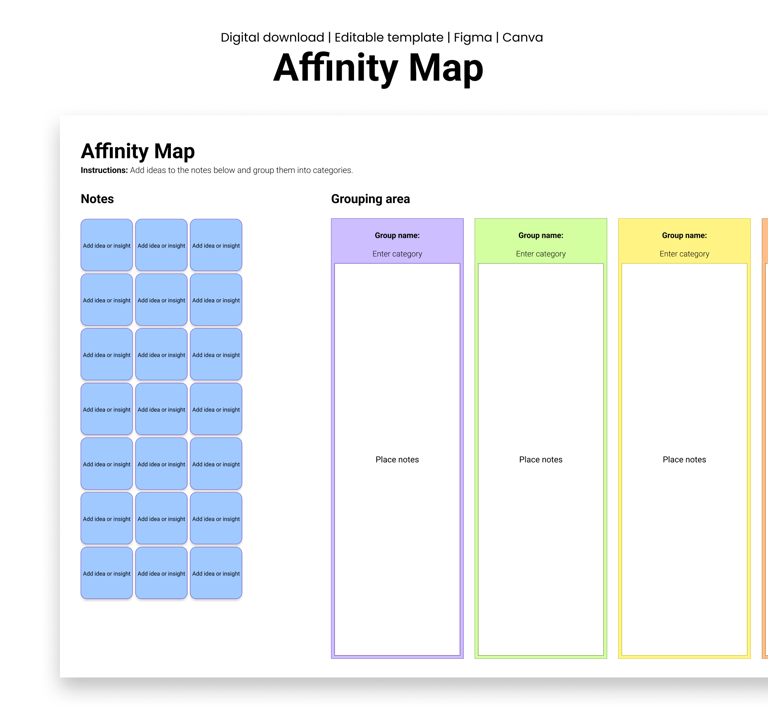
Affinity mapping is grouping qualitative data by putting a bunch of sticky notes with ideas on them on a wall and sorting them into clusters based on their similarities (affinities). It’s very useful in the synthesis phase of a design lifecycle. This method helps design teams to take small breaks to make sense of what they’ve learned rather than jump into solving problems.
These two research methods are both powerful and effective in their ways. While affinity mapping helps you better understand the past (research), mind mapping enables you to imagine the future (ideas). Simply put, one method organises, and the other explores. When used intentionally and at the right time, both can enhance your design process.
A bonus tip is that you can combine them. Begin your ideation process with a mind map, explore possible related ideas and topics, then wrap up with an affinity map to group feedback and team input.


While affinity mapping helps to order information for the team, mind mapping opens up more possibilities for them.
When to use each research method
To choose between the affinity mapping and mind mapping methods, you have to determine what stage of design you’re in and what you want to achieve.
Apply affinity mapping when:
You are done with research and need to understand the data better
You are interested in finding pain points or themes in user feedback
You are working with a team aligning around insights
Apply mind mapping when:
You are about to start a new project and are searching for ideas
You need to break down a broad topic or challenge
You want to creatively brainstorm without a defined structure
Here’s a Quick Decision Checklist:


Common use cases
Organising user research notes
Synthesising usability testing feedback
Clustering ideas in a workshop
A good example is after a round of user interviews, a research team will most likely use affinity mapping to group comments into themes like “missing features,” “confusing navigation,” or “positive feedback.”
What is mind mapping?
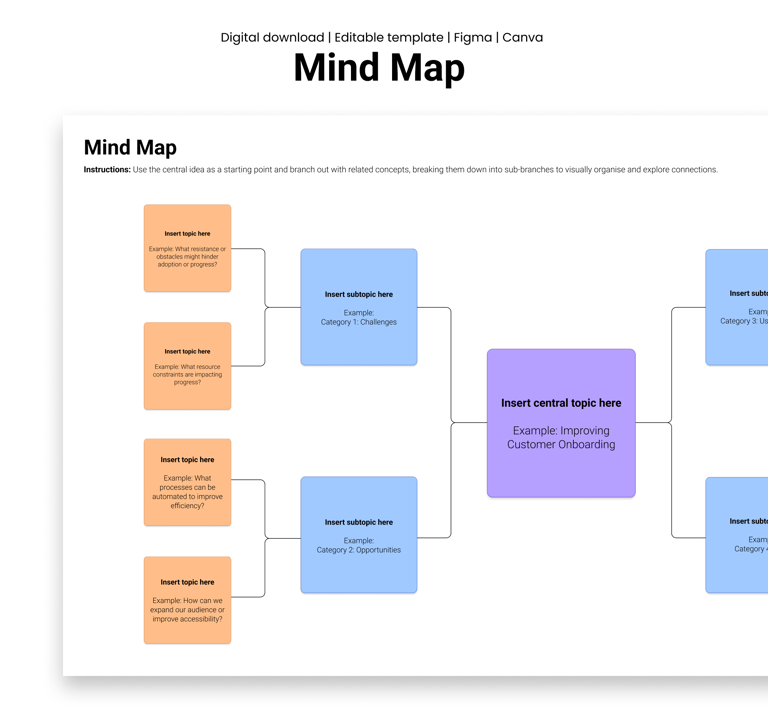
Mind mapping is more about visual idea generation. The technique starts with a central topic and branches outward, exploring related thoughts, questions, or ideas. Mostly employed in the ideation phase of design, it encourages creativity and identification of connections and expands one's thinking into different directions. Unlike affinity mapping, which is focused on organising data, mind mapping taps into free association, so it’s more like brainstorming.
Common use cases
Generating feature concepts
Exploring product ideas
Planning the user journey
A good application of this is when a service designer uses mind mapping to explore different directions for a new onboarding experience. The main topic will be “first-time user” and branch out into needs, emotions, and feature ideas.
Differences between affinity mapping and mind mapping
It’s true that both research methods can be done with sticky notes and may seem similar on the surface, but what are the key differences between them?
Design resources that deliver results
Copyright © Veilworx Ltd 2024. All rights reserved.
Registered in England and Wales.
Company number: 15318142

Contact
Email: contact@veilworx.com
Address:
Office 9944, 182-184 High Street North East Ham London
E6 2JA
Business hours:
Monday to Saturday: 10am to 6pm
Sun: Closed