
How startups can do smart user research without slowing product development
Ask the right questions, choose efficient research methods, and gather insights that drive decisions, without delaying product development.
USER RESEARCH


It's common practice for startups to skip user research, and this is not because they don't care about users, but rather, they prioritise speed and traction and are focused on other priorities. The problem with skipping research entirely is that it can backfire. Many things could go wrong because the team is operating on assumptions. The solution to this is having a Minimum Viable Research Plan. This is a light, strategic plan that will simultaneously save time and prevent unnecessary rework. This guide outlines how to do just enough research to stay user-centred without slowing down.
What's a minimum viable research plan?
Think of it the same way you think about MVP for product managers. You're not building the whole thing; you're testing and learning along the way; that's how this works too. Minimum viable research is used to ramp up effective user research processes quickly and get just enough user insight to reduce risk and make the right next decision. While it is meant to speed up the process, it's not an avenue or excuse for cutting corners.
Do startups need a minimum viable research plan?
Short answer, yes. Minimum viable research borrows its modus operandi straight from lean methodology. Startups are fast, so you need more rapid feedback to match the tempo. This means that thoughtful conversations with the right users are more valuable than a polished survey with a low response rate. For example, say you're validating a new onboarding flow, it's unnecessary to spend weeks writing a 20-question usability study that no one wants to answer. A simple and faster approach would be to run three short user interviews, observe where they get stuck, and use what you learn to iterate confidently. That's your lean research plan in action, and it has helped to quickly validate assumptions while keeping the team focused on real user needs.
Components of a minimum viable research Plan
First things first, define your core problem or hypothesis: Clarity is essential in ensuring your Minimum Viable Research Plan works in a startup. What’s the specific thing you aim to learn? Asking "Why are users dropping off after sign-up?" is a better starting point than a broad "Let's understand our entire onboarding journey." Defining the “why” in this context narrows down the focus and keeps everyone aligned.
Choose your methods: Once you have the right question, the next step is to choose 1 or 2 lightweight methods to get your answers. It is up to your discretion to select one that works better with your overall idea. This could include either live user interviews, testing a clickable prototype, or sending a short survey to your waitlist.
Set SMART, clear research goals: What do you need to know, when, and what would that knowledge influence? Let’s say you're trying to choose between two pricing page designs. Your research goal can't be to "get feedback;" it should be more like "understanding which layout better supports decision-making for first-time users." When you know exactly what the insight will help you do, your process remains lean, and your team stays focused. Remember to keep yourself time-bound, as speed is important to this lean research structure.
Practical tips for startups using minimum viable research
Simplicity is key. Use tools you already have to share what you've learned; no need to get all fancy. A quick summary in Notion or a one-pager in Google Docs is enough. You can even get pre-made user research plan templates from Veilworx, to keep things lightweight and straightforward. If you start drawing up a whole research document that no one ends up reading, there will be a lot of missed opportunities.
Keep your sample size small. Talk to 5 users, not 50. Remember that you're trying to speed things up. After your research, reuse your findings in future iterations. Don't let your past user research go to waste when you can reapply it to another aspect down the line and save everyone even more time.
Using a minimum viable research plan
Theres usually an assumption that user research slows momentum, but using a minimum viable research speeds things up. You make smarter calls with fewer guesses. So instead of launching with no research at all and fixing things later, you can build with your users in mind from the start.
All you need is an intention, a straightforward question, and the discipline to talk to your users before you build. Talk to five or six users. Take notes. Share what you learn internally. Then build! User research should not wait until you scale. Start small.
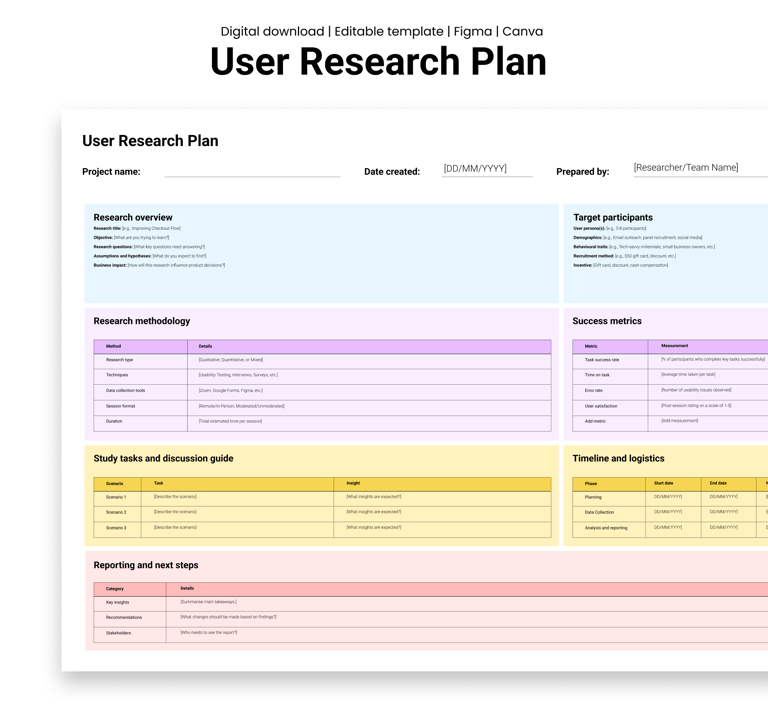
To build your next product sprint on actual user insight, use this one-page Minimum Viable Research Plan template and be on your way to fast, effective research.
Design resources that deliver results
Copyright © Veilworx Ltd 2024. All rights reserved.
Registered in England and Wales.
Company number: 15318142

Contact
Email: contact@veilworx.com
Address:
Office 9944, 182-184 High Street North East Ham London
E6 2JA
Business hours:
Monday to Saturday: 10am to 6pm
Sun: Closed